Most people come to Gruyères for the castle, but the best reason to stay longer in this little town is the food.
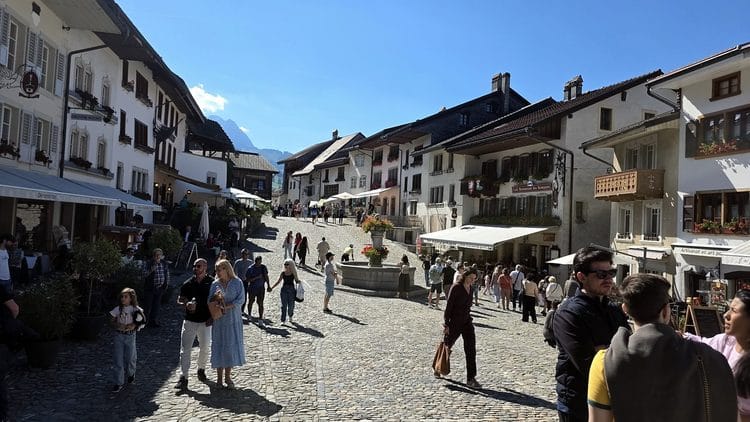
I grew up in Solothurn, and like most Swiss people, I knew Gruyère cheese long before I ever set foot in the town it comes from. We drove down by car, left it below the hill, and stayed in the old town until late afternoon. A good part of that day was about what we ate and drank.
This is a guide to eating your way through Gruyères: the cheese, the dessert the region is really built around, where fondue fits in, and the strangest coffee break in Switzerland.
Le Gruyère AOP: Why the Cheese from Here Is Different
Stand at the edge of the old town and look down into the valley, and you see where it all starts: green fields, scattered farms and cows. The milk for the cheese does not travel far. A dairy may use only milk from nearby farms, and it has to be raw, so the cheese still tastes of the grass of this region.
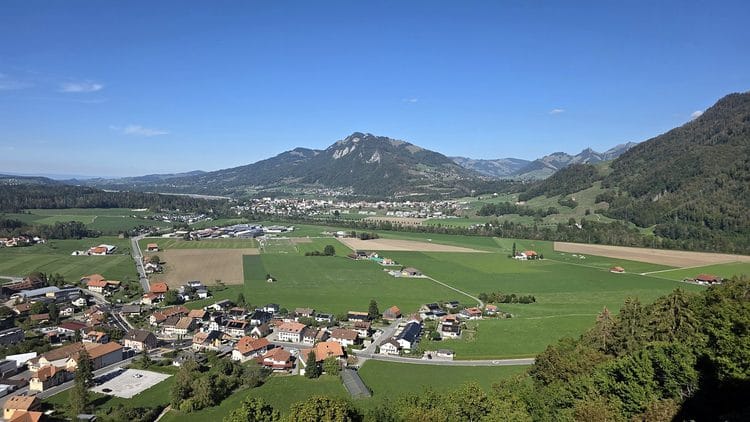
That is the idea behind the AOP label, Switzerland’s protected designation of origin. Real Le Gruyère AOP can only come from a defined area, mainly Fribourg canton plus parts of the neighboring cantons. The cows eat grass and hay, never fermented feed. The cheese is still made in copper vats, by hand and in small batches.
Each wheel carries a stamp that tells you which dairy made it and when, a bit like a birth certificate. People here like to point out that the cheese is mentioned in documents from the 12th century, and that it is still among the best in the world today: in 2025, a Gruyère from a dairy in the Bernese mountains won the title of world champion at the World Cheese Awards, which took place in Switzerland that year.
Which Gruyère to Taste
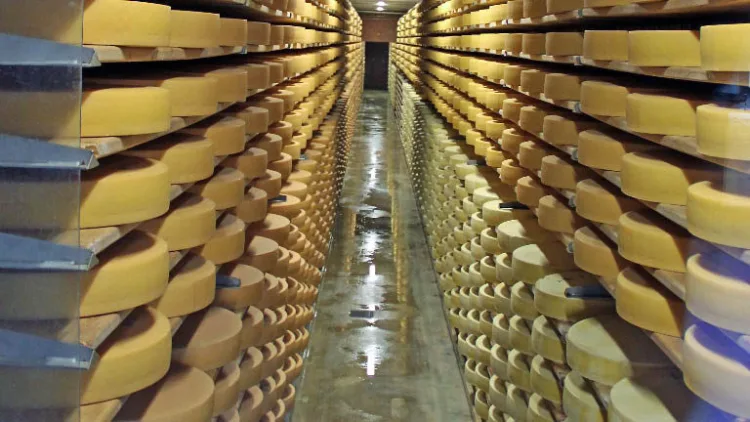
When you taste or buy Gruyère here, you will notice it is not one cheese but several, depending on age:
- Classic: the youngest version, mild, nutty and creamy. The usual choice for fondue.
- Réserve: aged ten months or more, firmer and stronger, with small crunchy crystals you can feel when you bite.
- Old wheels of 18 months and more: intense and slightly crumbly, best on their own with a glass of white wine. The 2025 world champion was one of these.
- Le Gruyère d’Alpage: made only in summer, in small mountain dairies on the alpine pastures, where the cows eat wild herbs and flowers. You find it less often, so try it when you see it.
My advice is to taste a young and an old one side by side. The difference is bigger than most people expect.
Back home, read the label carefully. Outside Switzerland and the EU, especially in the US, “gruyere” can be printed on almost any similar hard cheese. Only the words Le Gruyère AOP guarantee that it comes from here.
Watching It Being Made at La Maison du Gruyère
The easiest place to see the cheese being made is La Maison du Gruyère, the show dairy opposite Gruyères train station, at the bottom of the hill. Through big viewing windows, you see the cheesemakers work the copper vats, and there is a tasting of Gruyère at different ages.
My tip: go to the dairy first, before you walk up to the old town. It is right next to the car park and the station, so you don’t have to come back down the hill later. Cheesemaking happens mostly in the morning and around midday.
Meringues with Double Cream: The Dessert You Cannot Skip
Gruyère gets all the attention, but if you ask me what to eat in Gruyères, my answer is meringues with double cream.
The dessert has only two parts. The first is crisp, airy meringue. The second is the local double cream, so rich that it barely moves when you tip the bowl. It is not sweetened and not whipped. It simply comes like that from the dairy, with about half of it being fat. Restaurants often bring it in a little wooden pot, and you do the rest yourself: crack the meringue, spoon the cream over it, eat, repeat.
It sounds too simple to be special, but the contrast is the point: sweet and crunchy against cool and thick. For generations it has been the final course of the Bénichon, the big harvest feast of Fribourg canton. You will find it on the menu of nearly every terrace and tearoom up in the village, so there is no need to hunt for one famous address. Just leave room after lunch.
If you visit in September, look out for the Bénichon itself. Villages around the region celebrate the end of the alpine summer with a long festive meal. The table usually also has cuchaule, a sweet saffron bread, served with Bénichon mustard, a sweet and slightly spicy spread. It sounds strange, but it is one of the most typical tastes of the Canton of Fribourg.
Fondue in the Land of Gruyère
You cannot talk about food in Gruyères without fondue. The classic version from this canton is fondue moitié-moitié, “half and half”: half Gruyère and half Vacherin Fribourgeois, the creamier local cheese. It is softer and milder than a fondue made with Gruyère alone.
Two things most visitors do not know.
- First, for the Swiss, fondue is a winter thing: we eat it when it is cold and dark outside, roughly from October to March. In summer it is a dish for tourists, although nobody will stop you.
- Second, there is a tradition at the table: whoever drops their bread into the pot buys the next round.
If you want to know which other Swiss dishes are worth trying, from rösti to raclette, I put them all in my guide to Swiss food.
An Alien Coffee in the HR Giger Bar
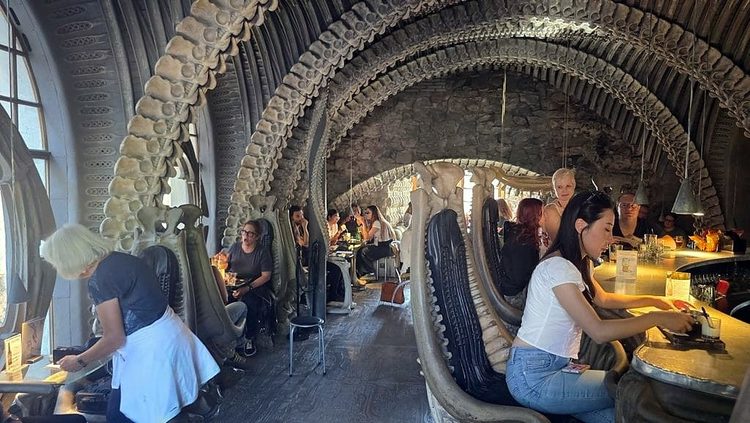
After all that cheese and cream, you need a coffee, and in Gruyères there is a unique place for it.
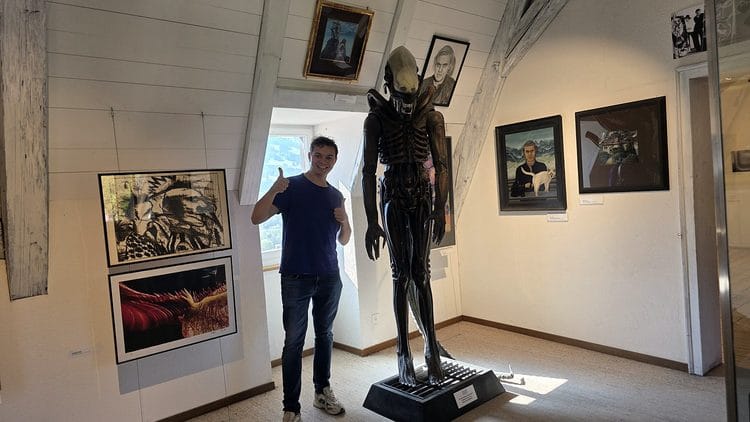
Few people expect a link between a cheese village and Hollywood, but H.R. Giger, the Swiss artist behind the monster in Alien, chose Gruyères as the home for his life’s work. Next to the HR Giger Museum is the HR Giger Bar, and you really drink your coffee inside one of his designs: the ceiling is a row of arches that look like vertebrae, and the chairs are shaped like ribcages.
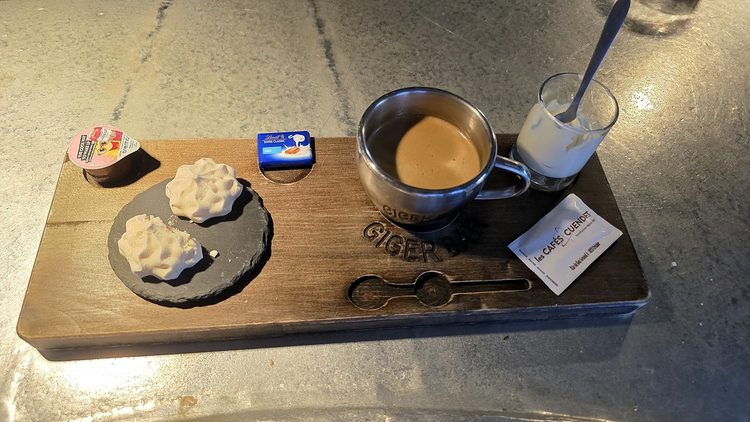
My order was the Alien Coffee. You can have it with or without a shot of alcohol, which is handy if you still have to drive, and the small meringues on the board are a nice nod to the dessert from earlier. If you want photos of the room, sit down and order something first. The staff is used to people who come in just for pictures, and they will politely ask them to have a drink or move on. For a seat inside one of the strangest rooms in Switzerland, one coffee is a small price.
Chocolate in Broc: The Sweet Detour
If you still have space, La Maison Cailler, the chocolate factory of one of Switzerland’s oldest chocolate brands, is in Broc, a few minutes from Gruyères by bus or car. Factory tours start several times per hour.
Cheese in the morning and chocolate in the afternoon is about as Swiss as a day can get. From Montreux, the seasonal Chocolate Train combines both in one trip. It runs from spring to autumn, and you need to reserve.
Tips for a Food Day in Gruyères
- You cannot drive into the old town. The medieval center is car-free. Park only at clearly marked parking lots. The easiest option is usually below the town near the station and La Maison du Gruyère; walk 10 to 20 minutes uphill, with some stairs. Wear proper shoes: the cobblestones get slippery when wet.
- By train, Gruyères is easy to reach from Lake Geneva. From Montreux, it takes about 1 hour 10 minutes on the Golden Pass line with a change in Montbovon, or from Lausanne, about 1 hour 15 minutes via Palézieux and Bulle. All the connections, including from Geneva and Vevey, are in this overview of public transport to Gruyères.
- Start early. You can catch the cheesemaking at the dairy and be in the old town before the day-trip crowds arrive around lunch in high season.
- Plan your money. Eating out in Switzerland is expensive, and a cheese-and-dessert day adds up quickly. I break down realistic prices in my article on how much a trip to Switzerland costs.
- Combine food with sights. The castle and the museums are all within a five-minute walk of each other. For something calm after the Giger Museum, the Tibet Museum is just a few doors away. My complete guide to Gruyères has all the sights and the combi tickets.
What to Bring Home from Gruyères
- Le Gruyère AOP, ideally one young and one old piece. Ask for it vacuum-packed if you are flying.
- Meringues, which travel well in their box and taste much better than supermarket ones.
- Cuchaule, the saffron bread, if you find it at a bakery. It keeps for a few days.
- Swiss chocolate from Broc, if you add the chocolate factory to your day.
Double cream is the one souvenir that does not travel: it needs to stay cold, so enjoy it on the spot.
Is Gruyères Worth Visiting for the Food?
Yes. Gruyères is one of the few places where you can see a world-famous cheese being made, eat a dessert in the region where it was born, and drink a coffee inside an extraordinary interior designed by the artist behind the Alien film set, all within a short walk. Come hungry, start at the dairy, and do not leave without meringues and double cream.
About the author: Max grew up in Solothurn, spent three years living in Tokyo, and studied in Seoul. Back in Switzerland, he shares travel guides about his home country, Japan, and Korea on Max on the Move.